Showing posts with label Ibaadah. Show all posts

Wednesday, February 14, 2007

Difference Between Sahabah And You & Me (#3)

Abu Hurairah (May Allah be pleased with him) reported: The Messenger of Allah (Sallallahu Alayhi Wasallam) said, "The world, with all that it contains, is accursed except for the remembrance of Allah that which pleases Allah; and the religious scholars and seekers of knowledge." [At-Tirmidhi]

Ulama write in the commentary of this Hadith: "It does not mean that this world, and whatever is in it, is really cursed. What it in fact means is that such things of this world are cursed which make a person negligent of the remembrance of Allah; or it is cursed for those who in their whole life do not remember Allah." The following famous saying by Maulana Yusuf Kandhalwi (r.a.) highlights the importance of not neglecting Zikr nor Ilm:

"Ilm without Dhikr is darkness and Dhikr wihtout Ilm is the door of Fitnah."

That's why it of utmost impotance that we daily spend some time for the remembrance of Allah Subhanahu Wa Ta'ala and as well the learning and/or teaching of sacred knowledge.

Seeking & Acquiring Ilm (Knowledge)
In order to seek benefit directly from Allah the Almighty, Allah Subhanahu wa Ta'ala himself has made it obligatory on every single Muslim to acquire divine knowledge. In other words to make effort in acquiring knowledge is required to obey and act upon the commands of Allah under the directives of the Prophet (Sallallahu Alayhi Wasallam). On top of that in many Ahadith great virtues have been ascribed to the seeking of divine knowledge for the sake of Allah Ta'ala.

Abu Hurairah (May Allah be pleased with him) reported: The Messenger of Allah (Sallallahu Alayhi Wasallam) said, "Allah makes the way to Jannah easy for him who treads the path in search of knowledge." [Muslim]

The Sahabah (r.a.a.) were so eager to learn, that they wished they could learn from Rasulullah (Sallallahu Alayhi Wasallam) throughout the whole day and night. They were really in the possession of vast of knowledge.

Hadhrat Abu Dharr (r.a.a.) said, "Rasulullah (Sallallahu Alayhi Wasallam) left us with so much knowledge that even when a bird fluttered it's wings in the sky, it would remind us of something he had taught us." [Ahmad]

Hadhrat Mu'adh bin Jabal (r.a.a.), one of the most learned amongst the Sahabah, expressed his love towards knowledge in the following: "Acquire (divine) knowledge because learning it is fear of Allah, going out in search of it is Ibaadah, rehearsing it is Tasbeeh, discussing it is Jihad, teaching it to those who do not know is Sadaqah and spending it on those worthy of receiving it promotes nearness to Allah. This is so because knowledge highlights what is Halal and what is Haram, it is a beacon for people on the road to Jannah, it is a companion in loneliness, a friend in the wilderniss, a partner to talk to in solitude and a guide in prosperity and in adversity. Knowledge is also a weapon against the enemy and makes one shine out when amongst friends. Allah elevates nations by virtue of this knowledge, making them leaders in virtue so that people follow in their footsteps, emulate their actions and always adopt their opinions. In addition to this, the angels are eager to be with them and rub their wings against them. Everything on land and water seek forgiveness for them, even the fish and other creatures in the oceans and the wild and tame animals on land. This is all because (divine) knowledge brings life to hearts (that have died after suffering) from ignorance, it is a lantern of the eyes against darkness and by virtue of this knowledge, a person reaches the ranks of the chosen ones (of Allah) and elevated stages in this world as well as in the Akhirah. Thinking deeply about such knowledge equals fasting while learning and teaching equals standing in Salaah. It is because of this knowledge that family ties are maintained and the lawful is distinguished from the unlawful. This knowledge is the leader of deeds and all deeds follow from it. It is only the fortunate who are inspired with it, while those deprived of it are most unfortunate.
" [Abu Nu'aym in his Hilya]

Even on his deathbed Mu'adh bin Jabal (r.a.a.) was remembering his "good friend". When he was on his deathbed, he asked the people to see wether dawn had broken. When they reported that it had not yet come, he again sent them to see. After this happened several times, they eventually reported to him that dawn had broken. To this, he said, "I seek Allah's protection from the night followed by a morning that takes one to Jahannam. I welcome death with open arms. It is that long absent visitor and a friend in need. Oh Allah! While I had always been afraid of You, today I long to meet You. Oh Allah! You know well that I never loved this world or to live long here to dig canals or to plant trees. I loved it only for the thirst in the extreme afternoon heat (when fasting), for enduring times of hardship and to sit on my knees when associating with the Ulema in gatherings of knowledge." [Abu Nu'aym in his Hilya]

Acting upon Ilm
It's not so hard to find a 12 year old Hafiz-ul-Qur'an nowadays. But why took it Hadhrat Umar Farooq (r.a.a.) then around 12 yers to complete the memorization of Surah Al-Baqarah alone? His Ustad was our eternally blessed Prophet Muhammad (Sallallahu Alayhi Wasallam) and the classroom was Baitullah and later Masjid-Nabwi - can any Madrassa, Darul Uloom or any other facility on the world keep up with that? And Hadhrat Umar (r.a.a.) wasn't of the un-intelligent sort either. Remember, it's the one about who Prophet Muhammad (Sallallahu Alayhi Wasallam) said, that if there was coming another Prophet it would be him. Maybe he had Tajweed problems? Well, I don't think so. The right anwser is, that it took him almost 13 years, because he wouldn't proceed to the next Ayaat before practicing on the Ayaat before.

The Sahabah (r.a.a.) were fully aware of the fact, that without practicig upon the learned knowledge brings nothing good. When we hear about so and so walked for months to just gain a single Hadith, do you seriously think their intention was just to learn it by heart and not to practice upon it? When we read Bukhari Shareef, Muslim, Mawata Malik or Tirmidhi we're actually reading the same Ahadith, that the Sahabah (r.a.a.) heard. But what's the difference except that they learned from the best teach ever? They acted upon it and through that their whole life changed.

There was a Sahabi (r.a.a.) and he asked Rasulullah (Sallallahu Alayhi Wasallam) for an advice. Rasulallah (Sallallahu Alayhi Wasallam) told him to never lie. Now, always when the time for prayers, fasting or other obligations came and it felt hard him, he told himself: "Rasulallah (Sallallahu Alayhi Wasallam) told me not to lie, so what will I tell him when he asks me if I prayed?!" So, at the end he was fulfilling his duties and this single advice changed his life and made it easy for him to follow the commands of Allah Subhanahu wa Ta'ala. Now, who of us doesn't know how evil it is to lie? Even in the eyes of non-Muslim civilization lying is a blameworthy act. We read one Hadith book after the other, but if we would actually act upon some of the Hadith and divine knowledge we acquire, we fould get the taste of what made the Sahabah love Ilm.

Spreading Ilm
The purposes of divine knowledge are of three: (1) Acquiring, (2) Practicing and (3) Spreading. So, remains only the third undiscussed: Spreading acquired knowledge to fellow Muslims and as well non-Muslims. In the following Ahadith the learned one's duty of teaching others is being made very clear.

Sahl bin Sa`d (May Allah be pleased with him) reported: The Prophet (Sallallahu Alayhi Wasallam) said to `Ali (May Allah be pleased with him), "By Allah, if a single person is guided by Allah through you, it will be better for you than a whole lot of red camels." [Al-Bukhari and Muslim]

Abu Hurairah (r.a.a.) narrates that the Prophet (Sallallahu Alayhi Wasallam) said: "He who obtains knowledge and then does not teach it, is like that who amasses a treasure then does not spend it out." [Al-Targhib: 122/1]

Abu Hurairah (r.a.a.) narrates that the Prophet (Sallallahu Alayhi Wasallam) said: "Who was asked about something pertaining to religious knowledge and he knowingly concealed it, Allah will bridle him with the fire on the Day of Resurrection." [Abu Dawud: 3658]

That's why there were always Halqah of teaching and learning alive in the Prophet's Mosque. Of course this obligation has to be taken very serious by the Ulema, but the rest of the Ummah shouldn't neglect it either. If you know only one Ayah, then pass it on.

And no slave will pass the Day of Judgement without being asked about the Knowledge that Allah Subhanahu wa Ta'ala granted him and how he made use of it. What better anwser can there be than: "Oh Allah! I practiced upon it myself and taught it to others only for Your sake."?

Importance of Dhikr
It's crystal clear, that if a person is engaged in learning and teaching, that the cursed Shaytan will try to gain something even from that. He'll try to plant Kibr in your heart for example. You'll start liking being called "Shaikh" by others and when you enter the room everyone will stand up for you. To abstain from this danger, we've as well to spent energy and time for the remembrance of Allah Subhanahu wa Ta'ala - Zikrullah.

There exist different forms of Zikr: Talking about Allah's attributes can be Zikr, making Astaghfar or Tauba can be Zikr, Tasbeeh can be Zikr, listening to Hamds can be Zikr, reading Qur'an can be Zikr... In other words everything that engages you in the remembrance of Zikr counts as a form of Zikr. The thoughts and attention should be attached to Allah Ta'ala, there's no value of Zikr by the tongue without concentration towards Allah (tawajjud) in Allah Ta'ala's sight.

Hadhrat Urwa bin Zubayr (r.a.a.) says, "We were performing Tawaaf when I extended to Hadhrat Abdullah bin Umar (r.a.a.) my proposal to marry his daughter, he remained silent and offered no reply. 'Had he been happy,' I said to myself, 'he would have certainly given me a reply. By Allah! I shall never speak to him about it ever again.' It so happened that he reached Madinah before me and when I returned, I first went to the Masjid of Rasulullah (Sallallahu Alayhi Wasallam) and fulfilled the rights owed to him. I then went to Hadhrat Abdullah bin Umar (r.a.a.). He welcomed me most warmly and asked me when I had arrived. "Were you asking me about Sauda bint Abdullah (my daughter) at a time when we were performing Tawaaf and could think of Allah Ta'ala before our very eyes? Were you unable to meet me on another occasion?' 'It just happened to take place at that time.', I replied. 'Well,' he asked, 'what have you to say tpday (are you still willing to marry her)?' 'I am now even more eager,' I replied. Hadhrat Abdullah bin Umar (r.a.a.) then called his two sons Salim and Abdullah and married me to his daughter.

In numerous Ahadith the virtue of Zikr-Ilahi are pointed out. The Prophet (Sallallahu Alayhi Wasallam) even advices to be engaged so much with Zikr, that the non-believers think you're are insane and the munafiq (hypocrites) think you're showing off. Again the Sahabah (r.a.a.) in general loved to make their time useful by engaging in Zikr.

Hadhrat Mu'adh bin Abdullah bin Rafi (r.a.a.) reports that he was once present in a gathering with Hadhrat Abdullah bin Umar (r.a.a.), Hadhrat Abdullah bin Ja'far (r.a.a.) and Hadhrat Abdullah bin Abu Umayrah (r.a.a.). Hadhrat Abdullah ib Abu Umayrah (r.a.a.) related to them that he had heard Hadhrat Mu'adh bin Jabal (r.a.a.) say that he heard Rasulullah (Sallallahu Alayhi Wasallam) say, "There are two phrases, one of which rises no less than the height of Allah's throne, while the other fills the atmosphere between the heavens and the earth. They are 'La Ilaha Illallah' and 'Allahu Akbar'."

Hadhrat Abdullah ibn Umar (r.a.a.) then confirmed with Hadhrat Abdullah ibn Abu Umayrah (r.a.a.) saying, "Did you really hear him say that?" "Yes", came the reply. Hadhrat Abdullah ibn Umar (r.a.a.) then started weeping so much that his beard was drenched in his tears. Thereafter, he said, "These are two phrases that are very dear to me and which I recite very often." [Tabrani]

Gatherings of Zikr
Once Rasulullah (Sallallahu Alayhi Wasallam) went to a group of Sahabah (r.a.a.) and said to them, "What for are you sitting here?" They replied, "We are engaged in the Zikr of Almighty Allah, and are glorifying Him for His extreme kindness to us in that He has blessed us with the wealth of Islam." Rasulullah (Sallallahu Alayhi Wasallam) said, "By Allah, are you here only for this reason?" "By Allah!", replied the Sahabah (r.a.a.), "We are sitting here only for this reason." Rasulullah (Sallallahu Alayhi Wasallam) then said, "I asked you to swear not out of any misunderstanding, but because Jibraeel (a.s.) came to me and informed me just now that Almighty Allah was speaking high about you before angels."

Subhan'Allah, wouldn't we all love to get in our local newspaper or being mentioned in the radio? But there's Allah Subhanahu wa Ta'ala, creator of this universe with just one order, ready to talk high of us infront of the Angels, who praise Allah Ta'ala day in and out. The commentary by Mulla Ali Qari (r.a.) gives a nice view on this Hadith, he interprets the pride on the part of Almighty Allah to mean that He wants the angels to realize, "Despite the fact these humans are full of temptations, the Devil is after them, desires are inside them, the worldly needs chase them, and yet they are engaged in glorifying Almighty Allah, and so many deterrents cannot prevent them from doing Zikr; and therefore your Zikr and glorification, in the abscene of any such handicaps is omparatively insignificant."

Tilawat-e-Qur'an
The best way of remembering, praising and glorifying Allah Subhanahu wa Ta'ala is the recitation of the Qur'an Shareef. It's obvious because how can praise Allah better than he did it himself? The superiority of the Qur'an over all other words is like the superiority of Allah over all creations. Not only is the Qur'an a miracle this Ummah has been granted, but it's as well a guidance for the once who think about the meaning and content.

Hadhrat Hasan says, "Ameerul Mu'mineen Hadhrat Uthman bin Affan (r.a.a.) said, 'Had our hearts be pure, we would never get enough of the speech of Allah Ta'ala and I would not like a single day pass by without looking int the Qur'an.' When Hadhrat Uthman (r.a.a.) passed away, the pages of his Qur'an were in tatters because he was always looking into it so often."

That was a praiseworthy characteristic of Hadhrat Uthman (r.a.a.) which he is known for. But as well other Sahabah (r.a.a.)'s fevour of reciting the holy Qur'an was big.

Hadhrat Habeeb bin Shaheed narrates that when Hadhrat Naafi was asked about what Hadhrat Abdullah bin Umar (r.a.a.) used to do at home, he replied, "Something that others would not manage. He would perform wudhu for every salaah and recite from the Qur'an between every two salaahs."

Monday, February 12, 2007

Sincerity Illustrated

A certain saintly man says: "I went for haj and while making Tawaaf I saw a man making dua so earnestly, crying out so loudly, that the other people who were making Tawaaf became quite distressed, but his heart was not turned to Allah at all. Then in Mina I saw a man selling a thousand dinars worth of material but throughout the sale, his heart was not for one moment negligent of Allah."

This is how it is with us. All our Salaahs, Duas and Ibaadat are mere rituals without any inner reality. With wailing and crying, we utter words like parrots and we do not even know what we are saying. With Allah sincerity is of utmost importance. Noise and shouting is of no sequence.

[Shaikul Hadith Hadhrat Maulana Muhammad Zakariya Kandhlawi Sahab (r.a.) in Aap Beti Part V, p. 565]

Saturday, February 03, 2007

Sifatus Salaah: Hanafi Prayer Method In Light Of Sunnah

"Sifatus Salaah" is an excellent booklet originally written in Urdu by Shaikh Muhammad Ilyas Faisal dealing with the aspects of Salaah according to Hanafi Madhab and the evidences used by Hanafi scholars. Unfortunately, other brothers often criticise performing the prayers the Hanafi method and even leave us with doubts in the back of our mind, because we simply don't know. Now, you don't have to learn all these evidences by heart, but at least be convinced that there's nothing wrong with performing Salaat the Hanafi way - or matter fact as described by the other three great Imams.

Introduction
Very often the following question is posed to many people: "Do you follow the Deen of Imaam Abu Hanifa (R.A.) or the Deen of Rasulullah (sallallahu alaihi wasallam)?" "Obviously the Deen of Rasulullah (sallallahu alaihi wasallam)," comes the instant reply. The second question is then posed: "Why then do you call yourself a Hanafi?" The person not well versed is perplexed by this question. Doubts are then created in his mind. He soon starts gradually drifting towards the abandoning of taqleed i.e. following one of the four illustrious Imaams viz. Imaam Abu Hanifa (R.A.), Imaam Shafi'i (R.A.), Imaam Malik (R.A.) and Imaam Ahmad bin Hanbal (R.A.).

By means of the type of questions that have been mentioned above, a deliberate attempt is made to create a misconception in the minds of the unwary — that if you are a Hanafi, you are following the Deen of Imaam Abu Hanifa (R.A.), NOT the Deen of Muhammad (sallallahu alaihi wasallam). This is an absolute fallacy. Imaam Abu Hanifa (R.A.), Imaam Shafi'i (R.A.) and the other Imaams did not invent any Deen of their own. They strictly followed the one and only Deen — the Deen of Islam brought by Rasulullah (sallallahu alaihi wasallam). Their followers are hence also following the same Deen — the Deen of Rasulullah (sallallahu alaihi wasallam).


The Method of Salaah in the Light of Authentic Ahadith
by Shaikh Muhammad Ilyas Faisal, Madina al-Munawwara

Friday, December 29, 2006

The Language Of The Friday Khutbah

Today, in our local mosque I think a young man led the Jumu'ah prayer the first time and it was a debut for me, too. Because I always heard about Jumu'ah Khutbahs in other languages than Arabic, but I never witnessed it live so to speak - until some hours ago. I don't think my Jumu'ah Salah is now invalid, since it isn't even invalid if you completely miss the Khutbahs. Never the less I want to clear this point: Jumu'ah Khutbahs have to be in Arabic language - if the crowd understands Arabic or not doesn't matter. He did it exactly in the fashion explained below by Hadhrat Mufti Taqi Usmani (db) in his booklet "The Language of The Friday Khutbah":

It is sometimes argued that even if the Khutbah is delivered in a local language, it is always started by some Arabic words containing Hamd (praise to Allah Subhanahu) and Salah (prayer for Allah's blessing) for the Holy Prophet صلى الله عليه و سلم and at least one verse from the Holy Qur'an. This much is enough for fulfilling the necessary requirements of a valid Arabic Khutbah. After this necessary requirements, the rest of the Khutbah may be delivered in any language.

But this argument overlooks the point that it is a Sunnah that the Arabic Khutbah is followed by the Jumu'ah prayer immediately without considerable gap between the two. Therefore, this practice, too, is not in harmony with the masnoon way of delivering a Khutbah.


Our brothers who insist that the Friday Khutbah must be delivered in a local language are requested to consider the following points in the light of the foregoing discussion:

1. The consistent practice of the Ummah throughout centuries has been to deliver the Friday Khutbah in Arabic even in the non-Arab countries. Why should the contemporary Muslims deviate from the consistent practice?

2. Khutbah is a part of the Jumu`ah prayer, hence a mode of worship. The modes of worship are not open to our rational opinion. They have certain prescribed forms which must permanent act and should never be changed through our rational arguments. Once this door is opened in one form of worship, there is no reason why other forms are not subjected to similar changes. The argument in favor of an Urdu or English Khutbah may open the door for an Urdu or English Adhan and Salah also on the same analogy. The ways of worship are meant for creating a sense of obedience and submission. A Muslim is supposed to perform these acts as an obedient slave of Allah, without questioning the rationality of these acts, otherwise throwing stones on the Jamarat of Mina or rushing across Safa and Marwah are all apparently irrational acts; but, being the slaves of Allah, we have to perform these acts as modes of worship. This is exactly what the word 'Ibadah' means. Any alteration in these ways on the basis of one's opinion is contrary to the very sense and philosophy of 'Ibadah' or worship.

3. All the recognized schools of Islamic jurisprudence are unanimous on the point that delivering Friday Khutbah in Arabic is obligatory. Most of the jurists have gone to the extent that in case the Khutbah is delivered in any other language, no Jumu`ah prayer offered after it is valid. Some others (like Imam Abu Hanifah) hold the non-Arabic Khutbah as valid in the sense that the Jumu'ah, prayers offered after it is- not void, yet at the same time they hold this practice to be impermissible, which means that the impermissibility of a non-Arabic Khutbah is a point of consensus between all the recognized schools of Islamic Fiqh.

A deviation from such a consensus can hardly render a service to the Muslim community except to create differences and disputes between them. It may be seen that practically, this deviation has divided Muslims and their mosques into two groups. Even if it is accepted for the sake of argument that the non-Arabic Khutbah is permissible, it is at the most permissible and not obligatory, and if a permissible act may cause disunity among the Muslims, the greater interest of the Muslim Ummah requires that it should be abandoned. The Holy Prophet صلى الله عليه و سلم , dropped the idea of rebuilding the kabah on Abrahamic foundation merely because it might have created disputes, even though the proposed construction of the kabah was not only permissible, but also advisable. If such a pious act may be avoided for the sake of unity, the newly invented custom of delivering Khutbah in a non-Arabic language deserves all the more to be avoided for maintaining unity.

4. Those who believe that the Khutbah may be delivered in a non-Arabic language do not believe that the Arabic Khutbah is not permissible, while the followers of the four recognized schools of Islamic Fiqh believe that a non-Arabic Khutbah is not permissible. It means that an Arabic Khutbah is permissible according to all, while a non-Arabic Khutbah is not permissible . according to the majority of the Muslims in the world. Obviously, in such a situation, the preferable practice would be the one which is permissible according to all the Muslims, so that every individual may be satisfied that he is performing the required worship in a permissible manner.

Instead of making it a matter of prestige we should mould our ways in accordance with the interest of the Ummah as a whole. May Allah grant us Taufiq to act according to His pleasure.


Ameen.

Thursday, December 28, 2006

Preparation For Eid-ul-Adha

Eid-ul-Adha is just a few days away and to make this day of joy a complete success, we should learn about this days' Sunnahs and how the Eid Salah has to be performed.

Sunnahs of Eid-ul-Adha
The following ten Sunnahs count for both Eids of the year:
  1. To adorn oneself according to the Shariah.
  2. To have a bath.
  3. To use miswaak.
  4. To wear the best of clothing which one possesses.
  5. To apply perfume.
  6. To wake up very early in the morning.
  7. To go early to the eid-gaah.
  8. To offer the Eid salaat in the eid-gaah. That is, one should not offer Eid salaat in the musjid without any valid reason.
  9. To return from the eid-gaah taking a route that is different from the one that he had taken when going towards the eid-gaah.
  10. To go to the eid-gaah on foot.
But still there are some differences: Before going to the eid-gaah it is preferable to eat something on Eid ul-Fitr. But this is not the case in Eid ul-Ad'haa. On Eid ul-Fitr, it is sunnah to say the takbeers softly while going towards the eid-gaah. But on Eid ul-Ad'haa the takbeers should be said in a loud voice. It is preferable to offer the salaat of Eid ul-Fitr a little late. But for Eid ul-Ad'haa it should be offered early. For Eid ul-Ad'haa there is no sadaqatul fitr. Instead, there is the sacrificing of animals for those who can afford it.

Takbeer-e-Tashreek
Takbeer-e-tashreeq is wajib after every fard salaat. It is wajib to recite this takbeer in a loud voice. However, women should recite it in a soft voice. The takbeer-e-tashreeq is as follows:

Allahu-Akbar, Allahu-Akbar. La ila-ha ill-lal-lah. Allahu-Akbar, Allahu-Akbar. Wa-lilahill hamd.
(Allah is greater, Allah is greater. There is no god but Allah. Allah is greater, Allah is greater. And all praises are for Allah.)
This takbeer will be wajib on the condition that the fard salaat has been offered with jama'at and the place is a city. This takbeer is not wajib on a woman and a musafir. But if they are muqtadis of a person on whom this takbeer is wajib, then it will be wajib on them as well. However, if a munfarid, a woman or a musafir recites this takbeer, it will be better for them because according to Imam Muhammad and Imam Abu Yusuf rahmatullahi alayhima it is wajib on them as well. If the imam forgets to recite the takbeer, the muqtadis should immediately commence reciting it. They should not wait for the imam to commence.

This takbeer should be recited after the fajr salaat of the ninth of Zil Hijjah till after the asr salaat of the thirteenth of Zil Hijjah. This totals 23 salaats after which this takbeer is wajib. The takbeer should be recited immediately after the salaat. According to some ulama, it is also wajib to say this takbeer after the salaat of Eid ul-Ad'haa.

Performance of the Eid Salah
On this day of festivity and celebration it is wajib to offer two rakaats of salaat as a form of gratitude. The method of offering Eid ul-Adha salaat is as follows:

The following intention should be made: "I intend offering two rakaats wajib of Eid ul-Adha salaat with six wajib takbeers." After making this intention, he should commence his salaat. He must recite the thanaa' and then say Allahu Akbar three times. Each time that he says Allahu Akbar, he should raise his hands to his ears just as he does for the takbeer-e-tahreemah. After making the takbeer, he should let his hands rest at his sides. In-between each takbeer, he should pause to such an extent that he can read Sub'haanallah three times. After the third takbeer, he should not rest his hands but tie them. He should then read the ta'awwudh and bismillah, Surah Fatihah and another Surah. Thereafter, he should make his ruku and sajdahs and stand up as he normally does. In the second rakaat, he should first recite Surah Faatihah and another Surah. Thereafter, he should make three takbeers but after the third takbeer he should not tie his hands but leave them at his sides. He should then make one more takbeer and go into ruku.

It is makruh to offer any other salaat on that day at the place where eid salaat is offered - not before the salaat nor after it. However, it is not makruh to offer any salaat after the Eid salaat at home. But to do so before the Eid salaat is makruh at home as well. It is makruh for women and those people who do not offer Eid salaat to offer any nafl salaat before the Eid salaat. If a person misses his Eid salaat and all the other people have already completed their salaat, this person cannot offer his salaat alone. This is because jama'at is a prerequisite for the Eid salaats. In the same way, if a person joins the jama'at but for some reason or the other his salaat becomes invalid, then he cannot make qada of it nor will qada be wajib on him. However, if a few other people also join him, qada will become wajib. If for some reason the Eid salaat is not offered on the first day, then Eid ul-Fitr salaat could be offered on the second day. And Eid ul-Ad'haa salaat could be offered till the twelfth of Zil Hijjah. If the Eid ul-Ad'haa salaat is delayed till the twelfth without any excuse, it will still be valid. But it is makruh to do so. If the Eid ul-Fitr salaat is delayed without any excuse, the salaat will not be valid at all. Examples of excuses:

(i) the imam does not come to perform the salaat for some reason or the other, (ii) it is raining heavily, (iii) the date of the moon has not been established and it only becomes established after mid-day when the time for the salaat has already expired, (iv) salaat was offered on a cloudy day, and after the disappearance of the clouds it is realized that the salaat was not offered in its correct time.

If a person joins the Eid salaat at a time when the imam has already completed saying the takbeers, then if he joined the jama'at while they were still in the standing posture, he should immediately make the takbeers even if the imam is busy with his qira'at. If he joins the salaat while the imam is in ruku, he should make his takbeers only if he feels that he will be able to catch up with the imam in his ruku. But if he fears that he will not be able to catch up with the imam, he should go straight into ruku. Instead of reading the tasbeehs in the ruku, he should recite the takbeers. However, when he makes the takbeers in his ruku, he should not raise his hands. If the imam stands up from the ruku before he can complete his takbeers, he should not try to complete them. Instead, he should stand up with the imam. The takbeers which he missed will be forgiven.

If a person misses the first rakaat of Eid salaat, when he stands up to complete it, he should first recite Surah Faatihah, another Surah and then make the takbeers. Although, according to the rule, he ought to have made the takbeers first, he should not do this. Because if he does this, then the takbeers of both the rakaats will come one after the other. And this is not the method of any Sahabi. Therefore, the rule has been given contrary to this. If the imam forgets to say the takbeers and only remembers this while in ruku, he should say the takbeers in his ruku and should not return to the standing posture. But if he returns to the standing posture, it will still be permissible, i.e. the salaat will not become invalid. However, because of the large crowd, sajdah-e-sahw should not be made.

The Eid-ul-Adha Khutbah
The prerequisites and conditions that apply for the validity and compulsion for jumu'ah, apply for the Eid salaat as well. With the exception that for the jumu'ah salaat the khutbah is a prerequisite and fard, while for the Eid salaats it is not fard but sunnah. Furthermore, the jumu'ah khutbah is delivered before the salaat while for the Eid salaats, the khutbah is delivered after the salaat. However, listening to the khutbah of Eid is wajib just as it is wajib for the khutbah of jumu'ah, i.e. while the khutbah is being delivered, it is haraam to talk, walk about or offer salaat.

The khutbahs of Eid should commence with the takbeers. The takbeer should be said nine times in the first khutbah and seven times in the second khutbah. The rules related to qurbaani and takbeer-e-tashreeq should be mentioned in the khutbah of Eid ul-Ad'haa.

Du'a
Dua should be made after the Eid salaat, or even after the khutbah. Although this dua has not been established from the life of Rasulullah sallallahu alayhi wa sallam, the Sahabah, Taabi'een and even the Tabe Taabi'een, but because it is sunnah to make a dua after every salaat, it will be preferable to make it after the Eid salaat as well.

[Information taken from "Juma and Eid Salahs" by Maulana Ashraf Ali Thanvi (r.a.)]

Friday, December 22, 2006

From Riyaa To Ibaadat

This is a wisdom (hikma) my father always tells. He says, our elders give the advice not to stop someone from his acts of goodness, even if you know he is doing it for showing (riyaa). Here is the complete wisdom behind it explained by Hadhrat Hajji Imdaadullah Muhaajir-e-Makki (r.a.):

"Even if you are doing an act (of goodness) for the sake of riyaa (show), don’t abandon it. While initially it will be riyaa, later (by constancy) it will be transformed into aadat (habit). Ultimately, the aadat will become ibaadat." [The Mashaikh Of Chisht by Shaikhul Hadith Muhammad Zakariyya Kandhalwi (r.a.)]

First Ten Days Of Dhul Hijjah


Verily, the praise belongs to Allah Most High, and may the blessings of Allah and Peace be upon His Messenger Muhammad (sallallaahu 'alaihi wa sallam), and his family and companions, all of them.

Ibn Abbas (radhiAllaahu 'anhumaa) narrated that the Messenger of Allah (sallallaahu 'alaihi wa sallam) said, "There are not any days in which righteousdeeds done in them are more beloved to Allah than these days, i.e. the ten days (of Dhul-Hijjah)." They said, "O, Messenger of Allah, not even Jihad in the path of Allah?" He said, "Not even Jihad in the path of Allah Most High, except if a man goes out (for Jihad) with his self and his wealth, then he doesn't return with anything from that." [Bukhari]


Imam Ahmad narrated from Ibn 'Umar (radhiAllaahu 'anhumaa) that the Messenger of Allah Muhammad (sallallaahu 'alaihi wa sallam) said, "There aren't any days greater, nor any days in which deeds done in them are more beloved to Allah Most High, than these ten days (of Dhul-Hijjah). So, increase saying Tahlil (Laailaaha illallaah), and Takbir (Allahuakkbar) and Tahmid (alhumdulillaah) in them."


Read the rest of this Article...

More Useful Links:

Tuesday, December 19, 2006

Du'a By Mufti Husain (db)

I know it's already the third post today and there's already enough to read for today, but this is just something I had to listen to a couple of times today. Mufti Husain (db) from the Darul Uloom Al Madania starts the Du'a in Arabic and then continues in Urdu after some minutes. The reason I'm posting this is that it reminds me of something that Maulana Tariq Jamil Sahab (db) once said. He said, that Du'as are not supposed to be recited but rather begged from Allah Subhanahu Wa Ta'ala. I think we all - first of all me of course - can learn a little from what and how to beg from Allah Ta'ala from this Du'a by Mufti Husain Sahab (db).


Thursday, December 14, 2006

Difference Between Sahabah And You & Me (#2)


It's told that Karun was so rich, that he needed seventy camels to carry only the keys to his vaults. Can you imagine the amount of keys? But still he died without the most precious key in this world. If you still don't know what I'm talking about, here you go:

Jabir ibn Abdullah (r.a.a.) narrates that the Prophet (s.a.w.) said: "The key of Jannah is Salat and the key of Salat is Islamic cleanliness." (Musnad Ahmad)

Allah Ta'ala has made it obligatory for every believer to regularly worship him in form of the five daily prayers. Iblis has been cursed by Allah Ta'ala, because he refused to prostrate to a Makhluq (creation) - so, I should ask myself what will be my destination, if I refuse to prostrate to the Khaliq (creator)? May Allah Ta'ala give me and you the tawfeeq to never miss a single Salat again.

A Gift, Not A Burden

Our beloved Prophet (s.a.w.) personally had been given the Salat by Allah Subhanahu Wa Ta'ala at the night of Miraj. This fact alone should make us realize that the five obligatory prayers hadn't been given as a burden to the believers, but rather as a present. Otherwise Allah Ta'ala could've as well just sent Jibraeel (a.s.) with His order of prayers to Prophet Muhammad (s.a.w.).

The Sahabah (r.a.a.) understood the worth of Salat. And they saw Salat as a chance to get in direct contact with Allah Ta'ala, to directly ask from Allah Ta'ala, to solve their problems through Salat and get all their minor sins forgiven by Allah Ta'ala. If you look at the Ummahs before, you should notice the difference here: The Ummatis of Musa (a.s.) had to ask their Prophet to supplicate to Allah Ta'ala for them.

Not only reminded Allah's Messenger (s.a.w.) his Ummah of Salat at the time of his death, but in many other traditions the virtues ascribed to the right performance of Salat had been highlighted by our beloved Prophet (s.a.w.), too.

How To Perform Salat

Prophet Muhammad (s.a.w.) told his whole Ummah to pray exactly like he did and when someone took the Shahadah Salat was the first thing he taught the person. But what attributes did his prayers carry? He definitly was devoted and concentrated and would weep so much, that once even the ground around him became soaked, while engaged in Salat. If we could establish Salat like Abu Bakr (r.a.a.) or Umar (r.a.a.) we would be successful in this life and the hereafter without a doubt.

Hadhrat Sahl bin Sa'd says that Hadhrat Abu Bakr (r.a.a.) could not be distracted when performing salaah.

Hadhrat Mujaahid says, "Hadhrat Abdullah bin Zubayr (r.a.a.) would stand still like a stick in salaah, which was exactly as Hadhrat Abu Bakr (r.a.a.) used to do. That is what devotion in salaah means."


Hadhrat Abdullaah bin Shaddad bin Al Haad says, "I was standing in one of the last rows during the Fajr salaah and I could hear Hadhrat Umar (r.a.a.) cry aloud as he recited Surah Yusuf and reached the verse: "I complain of my sorrow and my grief only to Allah." (Surah Yusuf: 86)


Importance The Sahabah Gave To Salat

Hadhrat Miswar (r.a.a.) narrates that after Hadhrat Umar (r.a.a.) was stabbed, he fell into coma. Someone said, "If he is still alive, you will not be able to rouse him with anything more effective in jolting him than with salaah." Someone then said, "Salaah, O Ameerul Mu'mineen! The time for salaah has already set in!" Hadhrat Umar (r.a.a.) regained consciousness and said, "What! Salaah?! By Allah! I will then have have to perform it. There is no part in Islaam for the person who does not perform his salaah."


Hadhrat Muhammad bin Miskeen narrates that when the rebels surrounded the house of Hadhrat Uthman (r.a.a.), his wife said to them, "You wish to assassinate him?! Whether you kill him or leave him, he spends the whole night reciting the entire Qur'aan in a single Rakaah of salaah."


We struggle to stand up for Fajr prayers, but Hadhrat Umar ibn al-Khattab (r.a.a.) even regained consciousness from coma after hearing the call. We complain that our Imams pray so long Raka'ats and struggle to listen to the entireQur'an during a whole month, but Hadhrat Uthman (r.a.a.) recited the entire Qur'an in one Raka'at. Is there anyone among us, who gives such an importance to Salat like the noble companions of our beloved Prophet Muhammad (s.a.w.) did? I doubt it.

Tuesday, December 12, 2006

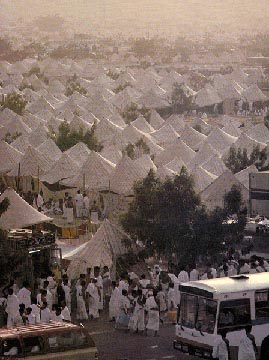
Errors Often Commited By Pilgrims

This is one chapter of the small booklet written by 'The Agency of Islamic Enlightement in Hajj' with the name "A Guide To Hajj, Umra, And Visiting the Prophet's Mosque". The guide is approved by the Permanent Committee of Islamic Research and Fatwa and Shaikh Muhammad Bin Saleh Al-Uthaimin (Hafizullah) and printed & distributed by the Ministry of Islamic Affairs, Endowments, Da'awah and Guidance (Kingdom of Saudi Arabia).

First: Errors Related to Ihram

Some pilgrims cross the designated stations of ihram (miqat) on their route without being in ihram or entering into ihram there. They wait till they reach Jeddah or some other place that is after the miqat at which they enter into ihram. This is against the command of the Messenger of Allah (s.a.w.) which stipulates that every pilgrim should enter into ihram at the station of ihram that lies on his route.

The one who crosses the miqat without going into ihram must go back to the miqat that lies on his route, and enter into ihram there. Otherwise he must make expiation by sacrificing a sheep in Makkah and feeding all its meat to the poor. This applies to all pilgrims, regarless of whether one passes the station of ihram by air, by sea, or by land.

If one's route does not pass through one of the five designated stations of ihram, he should enter into ihram at a point that is nearest to the station of ihram on his route.

Second: Errors Related To Tawaf

1. Starting the twaf before the Black Stone, while it is obligatory to begin tawaf from the Black Stone.

2. Doing the twaf inside the Hijr, which means going round only a portion of the Ka'aba rather than the whole of it, since the Hijr is a part of the Ka'aba. The circuit of the tawaf that he does going through the Hijr is invalid.

3. Doing raml (taking quick short steps) during all the circuits, while raml is to be done only during the first three circuits of the tawaf al qudoom.

4. Struggling violently to kiss the Black Stone, and sometimes even hitting or abusing people. Such actis, which are injurious to Muslims, are not permissible. It is not permissible to abuse or hit his muslim brother without a just cause.

It should be noted that the tawaf remains perfectly valid without kissing the Black Stone. If one does not or cannot kiss the Black Stone, it is sufficient to simply point to it, saying: Allahu Akbar, when he comes parallel to it, even if he may be a a disctance from it.

5. Touching the Black Stone with the intention of seeking blessings (barakah) from it is an innovation (bid'ah) with no basis in the Shari'ah of Islam. The sunnah is to touch it or kiss it as an act of obedience to Allah, the Most High.

6. Touching the four corners of the Ka'aba or its walls, and wipiing the face with the hands. The Prophet (s.a.w.) did not touch any part of the Ka'aba except the Black Stone and the Yamani corner.

7. Saying specific formulas of supplications for each circuit. The Prophet (s.a.w.) did not specify any supplications except the saying of Allahu Akbar when he reached the Black Stone, and at the end of each circuit between the Yamani corner and the Black Stone he used to say:

"Rabbana atina fid dunya hasatan wa fil akhirati hasanatan wa qina adhaban nar".

"Our Lord give us good in this world, and good in the Hereafter, and save us frm the torment of the Fire".

8. Raising one's voice above the voices of othersm which is done by some of the people doing tawaf or leading others to tawaf, as it causes confusion to the worshippers.

9. Struggling to pray at the station of Ibrahim. This is contrary to the sunnah, besides being injurious to other worshippers. It is sufficient to pray the two raka'ats of tawaf after completing one's tawaf anywhere within the Sacred Mosque.

Third: Errors Related To Sa'y

1. When climbing upon the mounts of Safa and Marwah, some pilgrims face the Ka'aba pointing towards it with their hands while saying: Allahu Akbar as if they were saying the takbir for salah. The sunnah is to raise the hands in the way you do when making du'a.

2. Accelerating one's pace throughout the entire distance between the two hills. The sunnah is to accelerate one's pace only between the two green posts, and walk at a normal pace for the remainder of the way.

Fourth: Errors Related To Arafat

1. Some pilgrims camp outside the boundaries of Arafat, and remain there until the sun has set, then they depart for Muzdakufah without actually standing at Arafat. This is a serious error, which invalidates their Hajj since standing in Arafat is the essence of Hajj, and itis obligatory to be within the boundaries and not outside. If it is not easy to do that, they may enter before sunset and remain the re until sunset. It is also acceptable to stand in Arafat specifically during the night of sacrifice.

2. Departing from Arafat before the sun has set is not permissible, because the Messenger of Allah (s.a.w.) stayed at Arafat until the sun had set completely.

3. Struggling through crowds in order to climb Mount Arafat is not permissible, because it causes much harm and injury to others. The entire plan of Arafat is a place of standing, and neither climbing Mount Arafat, nor making salah on it is recommended.

4. Making supplications facing Mount Arafat is incorrect, because the sunnah is to face the qiblah while making supplication.

5. Making heaps of earth or pebbles during the day of Arafat at particular places, by some people has no basis in the Shari'ah of Allah.

Fifth: Errors Related To Muzdalifah

Some pilgrims start collecting pebbles to throw at the stone pillars (the Jamarat) as soon as they arrive in Muzdalifah prior to even praying the Maghrib and 'Isha prayers. This is not right. It is also not right to hold the belief that the pebbles must be collected at Muzdalifah.

The correct thing is that the pebbles can be collected anywhere within the boundaries of al Haram (the Sacred precincts of Makkah). It is know that the Prophet (s.a.w.) did not ask that the pebbles for throwing the Jamratul 'Aqabah be picked for him from Muzdalifah, and on entering Mina. The rest of the pebbles were picked up for him from Mina too.

Some pilgrims wash the pebbles, but this is not prescribed in the Shari'ah.

Sixth: Errors Related To Throwing The Pebbles

1. Some pilgrims are under the impression that when they are throwing pebbles at the stone pillars, they are actually throwing the Satans (devils), hence they hurl them with rage and a shower of curses and abuses. No! The throwing of the pebbles was only prescribed for the remembrance of Allah the Most High.

2. Some people throw big stones, shoes or pieces of wood. This is an act of transgression in matters of religion which the Prophet (s.a.w.) prohibited, and doing that will not suffice for the throwing.

3. Jostling and fighting with others at the pillars while throwing the pebbles is not permissible. What is prescribed is to be gentle and to throw the pebbles without hurting anyone as much as possible.

4. Throwing all the pebbles at one time is an error. The scholars have said that this would be counted as only one throw. The Shari'ah prescribes that the throwing of the pebbles be done one pebble after another, saying: Allahu Akbar with each throw.

5. Delegating someone to throw the pebbles simply due to fear of the crowds or of hardship, while one is capable of doing it him or herself. Only the sick, or weak individuals are permitted to delegate someone to do the throwing for them.

Seventh: Errors Related To The Farewell Tawaf

1. On the day of their departure some pilgrims go to Makkah to perform their Farewell tawaf before throwing the pebbles at the Pillars, and then they return to Mino to throw the pebbles and depart from Mina for their respective countries. Thus their final rite becomes that of throwing the pebbles at the Pillars, and not of the tawaf round the Ka'aba. This is an error as the Prophet (s.a.w.) said: "No one should depart without his last visit being to the House (the Ka'aba)".

Accordingly, the Farewell tawaf must be done after one has completed all the rites of Hajj (and before starting his journes home). After his tawaf one should not stay in Makkah except for the time it takes to prepare departure.

2. After finishing the Farewell tawaf some people walk backwards, facing the Ka'aba when going out of the Sacred Mosque, with the impression that this is a veneration of the Ka'aba. This act in an innovation (bid'ah) in the religion and has no basis.

3. After finishing the Farewell tawaf some pilgrims stop at the door of the Sacred Mosque to make supplications. This is also an innovation with no basis in the Shari'ah of Islam.

Eighth: Errors Related To The Visit To The Prophet's Mosque

1. Rubbing one's hands on the walls and the iron grills, or tying threads and other acts of this sort while visiting the grave of the Prophet (s.a.w.) intending to receive blessings (barakah) from that, all these are innovations (bid'ah). Blessings come from following what Allah and His Messenger (s.a.w.) have prescribed, and not from following innovations.

2. Going to the caves of Mount Uhud, or to the caves of Hira or Thaur near Makkah, and hanging pieces of cloth, or making supplications there, which are not prescribed by Allah, and bearing unnecessary hardships are all innovations in the religion, and have no basis in the Shari'ah.

3. Likewise, visiting certain sites under the impression that these constitute relics of the Prophet (s.a.w.) for example the place where his camel knelt down (when he first arrived at Madinah), and the well of Uthman (r.a.a.), or the well of the ring and taking the soil of these places to obtain blessings are all innovations.

4. Calling upon the dead while visiting the graves at the Baqi' cemetery, or the graves of the martyrs of Uhud, and throwing coins in order to seek the blessings of the place, or the people buried there is a grievous error. In fact it is shirk (ascribing partners to Allah, the Most High), as has been pointed out by scholars, and is also clear from the Book of Allah and the sunnah of His Messenger (s.a.w.). This is because all forms of worship are for Allah alone, and it is not permissible to associate other than Allah in any of them, like invoking another besides Allah, or offering sacrifices or giving vows; or any other form of ibadah except for Allah alone. Allah, the Most High says:

"And they were commanded nothing except to worship Allah (only) purifying the religion for Him alone."

And He also says:

"Verily, the places of worship are for Allah (alone), so do not invoke anyone along with Allah."

We ask Allah, the Most High to improve the condition of the Muslims, and to give them understanding of the religion, and to turn all of us away from errors and deviations. Indeed He is the Hearing, the Responding.

Tuesday, November 28, 2006

Hajj/Umrah's Ahkam According To Your Madhab


Here are two lists. The first is about what should be avoided during the Ihram and the larger second one is about the things you are supposed to do during the Ihram. And just as the title already unveiled it's according to all four Madhahib. But first I want to give you two very interesting links corncerning Hajj, Umrah and visiting Medinah.

>> Journey of a Lifetime: Fisabilillah.org put together a Hajj Pack consisting of over 120 printable pages. This guide covers many aspects corncering "Before Hajj", "The Hajj", "In Madinah", "After Hajj" and it's all illustrated with text and images.
>> HajUmrah.co.uk: A non-profit site geared to provide a local independent directory of Hajj and Umrah Tour Operators, Travel Tips, Hajj and Umrah Books, Hotels, Visa information, News, Weather and a wealth of outstanding resources dedicated to Hajj & Umrah.


Now, we can start with the main part of this post. You just need to do another click, if you haven't yet.

  • 1.) Wearing sewn clothes:
All Madhahib: Requires sacrificing a sheep.
  • 2.) Male pilgrim covering the head or female pilgrim covering her face with Niqab:
Hanafiya: Requires sacrificing a sheep.
Shafi'iya: Doing so intentionally requires sacrificing a sheep. If done unintentionally or being forced to do so, then there's no Kaffarah.
Malikiya: Requires sacrificing a sheep.
Hanbaliya: Doing so intentionally requires sacrificing a sheep. If done unintentionally or being forced to do so, then there's no Kaffarah.
  • 3.) Intentionally pulling out or removing body-hair:
All Madhahib: When less than twelve hairs have been pulled out or removed, a handfull of wheat (or other appropriate food) has to be donated. But if more hairs have been removed, then a sheep has to be sacrificed.
  • 4.) Cutting of finger- or toenails:
All Madhahib: When one or two nails have been cut, accordingly one or two times food in the measure of Mudd (the amount that can be drawn with both hands put-together) has to be donated. But when more nails have been cut, a sheep has to be sacrificed.
  • 5.) Use of perfume:
All Madhahib: Requires sacrificing an animal (at least a sheep).
  • 6.) Hunting a wild animal or hunting and killing a wild animal:
All Madhahib: As Kaffarah (1) a sheep or a small livestock animal in the size of the killed animal has to be given or (2) feeding every of the amount of poor prescribed for Kaffarah a 1/2 Sa' (i.e. so much, that a person can eat full) or (3) instead of feeding, it can be fasted a day for every single of the poor.
  • 7.) Burning down, killing or chopping off living plants in the area of the Haram:
All Madhahib: Requires sacrificing an animal (at least a sheep).
  • 8.) Sexual intercourse or stimulation with your partner:
Hanafiya: Makes the Hajj or Umrah invalid and batil.
Shafi'iya: Makes the Hajj or Umrah invalid and batil - as long as the person hasn't been forced or did it unintentionally (i.e. without taking under consideration that one's in the state of Ihram).
Malikiya: Makes the Hajj or Umrah invalid and batil.
Hanbaliya: Makes the Hajj or Umrah invalid and batil.

That's it with the most important forbidden acts during the state of Ihram and the Kaffarah of all four Madhahib. The following list is (a little) larger and gives you the look at what importance the school of thoughts gave the different acts you are supposed to do. To make it easier I gave every Madhab an own color: Hanafiya is green, Shafi'iya is brown, Malikiya is blue and Hanbaliya is red.

  • The Hajj itself
Fardh* | Fardh** | Fardh* | Fardh*
* has to be performed immediately
** can be delayed

  • The Ihram for Hajj
Shart/Rukn | Rukn | Rukn | Rukn
  • The Umrah
Sunnah mu'akadda | Fardh** | Sunnah mu'akadda | Fardh*
* has to be performed immediately
** can be delayed
  • The Ihram for Umrah
Sunnah ghair mu'akadda | Sunnah ghair mu'akadda* | Sunnah ghair mu'akadda | Sunnah ghair mu'akadda
*(According to some Scholars of this Madhab: Wajib)
  • The reciting of the Talbiya during the Ihram
Shart* | Rukn | Rukn | Rukn
*(According to some Scholars of this Madhab: Rukn)
  • Enter Ihram at the Miqat
Wajib | Wajib | Wajib | Wajib
  • Ghusl on the occasion of the Ihram
Sunnah ghair mu'akadda | Sunnah ghair mu'akadda | Sunnah ghair mu'akadda | Mustahabb
  • The Talbiya
Sunnah ghair mu'akadda | Sunnah ghair mu'akadda | Wajib | Sunnah ghair mu'akadda
  • Tawaf al-Qudum
Sunnah ghair mu'akadda | Sunnah ghair mu'akadda | Wajib | Sunnah ghair mu'akadda
  • The Niyyat for Tawaf
Shart | Shart | Wajib | Shart
  • To start the Tawaf at the black stone (al-Hajar al-aswad)
Wajib | Shart | Wajib | Shart
  • Always having the Ka'ba at your left side during Tawaf
Wajib | Shart | Shart | Shart
  • Not being in the state of Hadath during Tawaf
Wajib | Shart | Shart | Shart
  • To perform the Tawaf in form of seven rounds (Ashwat)
Wajib | Shart | Shart | Shart
  • The two Rak'a on the occasion of the Tawaf
Wajib | Sunnah ghair mu'akadda* | Wajib | Sunnah ghair mu'akadda
*(According to some Scholars of this Madhab: Wajib)
  • The Tawaf at the Umrah
Rukn | Rukn | Rukn | Rukn
  • The Sa'y between as-Safa and al-Marwa at Hajj and Umrah
Wajib | Rukn | Rukn | Rukn
  • To perform the Sa'y after the Tawaf
Wajib | Shart | Wajib | Shart
  • To make a Niyyat for the Sa'y, to begin the Sa'y at as-Safa and finish it at al-Marwa
Wajib | Shart | Shart | Shart
  • To perform the Sa'y - if possible - walking
Wajib | Sunnah ghair mu'akadda | Wajib | Shart
  • To walk during all 7 rounds (Ashwat)
Wajib | Shart | Shart | Shart
  • To let the 7 rounds (Ashwat) of the Sa'y continuously follow eachother (Muwalat)
Sunnah ghair mu'akadda | Sunnah ghair mu'akadda | Wajib | Shart
  • To let the Sa'y follow directly after the Tawaf without an interruption (Muwalat)
Sunnah ghair mu'akadda | Sunnah ghair mu'akadda | Wajib | Sunnah ghair mu'akadda
  • Shaving or trimming the hair on the head at the Umrah
Wajib | Wajib | Wajib | Wajib
  • To spend the night of 'Arafat at Mina
Wajib | Sunnah ghair mu'akadda | Wajib | Mustahabb
  • The standing at 'Arafat (Wuquf 'Arafat)
Rukn | Rukn | Rukn | Rukn
  • The (permissible) time for standing at 'Arafat (Wuquf 'Arafat)
From the begin of Zuhr till the Fajr of the day of sacrifices (Yaum an-Nahr)
  • To perform the Wuquf before the sunset on the day of 'Arafat
Wajib | Wajib | Rukn | Wajib
  • To connect in real Jam'-form at Muzdalifa between the Maghrib prayer and the 'Isha' prayer
Wajib | Sunnah ghair mu'akadda | Sunnah ghair mu'akadda | Sunnah ghair mu'akadda
  • To spend the night at Muzdalifa
Wajib | Wajib | Wajib | Wajib
  • To set off on time from Muzdalifa to al-Mash'ar al-haram
Wajib | Wajib | Sunnah ghair mu'akadda / Mustahabb | Wajib
  • To stone the big pillar (Jamrat al-'Aqaba) at the day of sacrifice (Yaum an-Nahr)
Wajib | Wajib | Wajib | Wajib
  • Shaving or trimming the hair on the head at the Hajj
Wajib | Rukn | Wajib | Wajib
  • To keep the order (Tartib) of stoning the big pillar, sacrificing an animal and shaving the head
Wajib | Sunnah ghair mu'akadda | Sunnah ghair mu'akadda | Sunnah ghair mu'akadda
  • That the shaving of the head takes place inside the Haram (the Ka'ba area) and at the permissible days of sacrificing (Ayyam an-Nahr)
Wajib | Sunnah ghair mu'akadda | Sunnah ghair mu'akadda | Sunnah ghair mu'akadda
  • The Tawaf al-Ifada
Rukn | Rukn | Rukn | Rukn
  • To perform the Tawaf al-Ifada during the permissible days of sacrificing (Ayyam an-Nahr)
Wajib | Rukn | Wajib (at Hajj) | Sunnah ghair mu'akadda (on the day of celebration)
  • To perform the Tawaf al-Ifada after the stoning of the big pillar
Sunnah ghair mu'akadda | Sunnah ghair mu'akadda | Wajib | Sunnah ghair mu'akadda
  • The stoning of all three pillars (al-Jamarat) at the days of Tashriq
Wajib | Wajib | Wajib | Wajib
  • Not to delay the stoning of all three pillars (al-Jamarat) till the night
Sunnah ghair mu'akadda | Sunnah ghair mu'akadda | Wajib | Sunnah ghair mu'akadda
  • To spend the night at Mina during the days of Tashriq
Sunnah ghair mu'akadda | Wajib | Wajib | Wajib
  • The Tawaf al-Wada'
Wajib | Wajib | Mustahabb | Wajib

That's it! Insha'Allah that was helpful to some of you.
There will follow a couple of other posts concerning Hajj in the next few days: Definitly a history of the Ka'ba and a post about errors often commited by pilgrims. And part 2 of the "Difference between Sahabah and Me & You" is in the makings, too. So, stay tuned.